
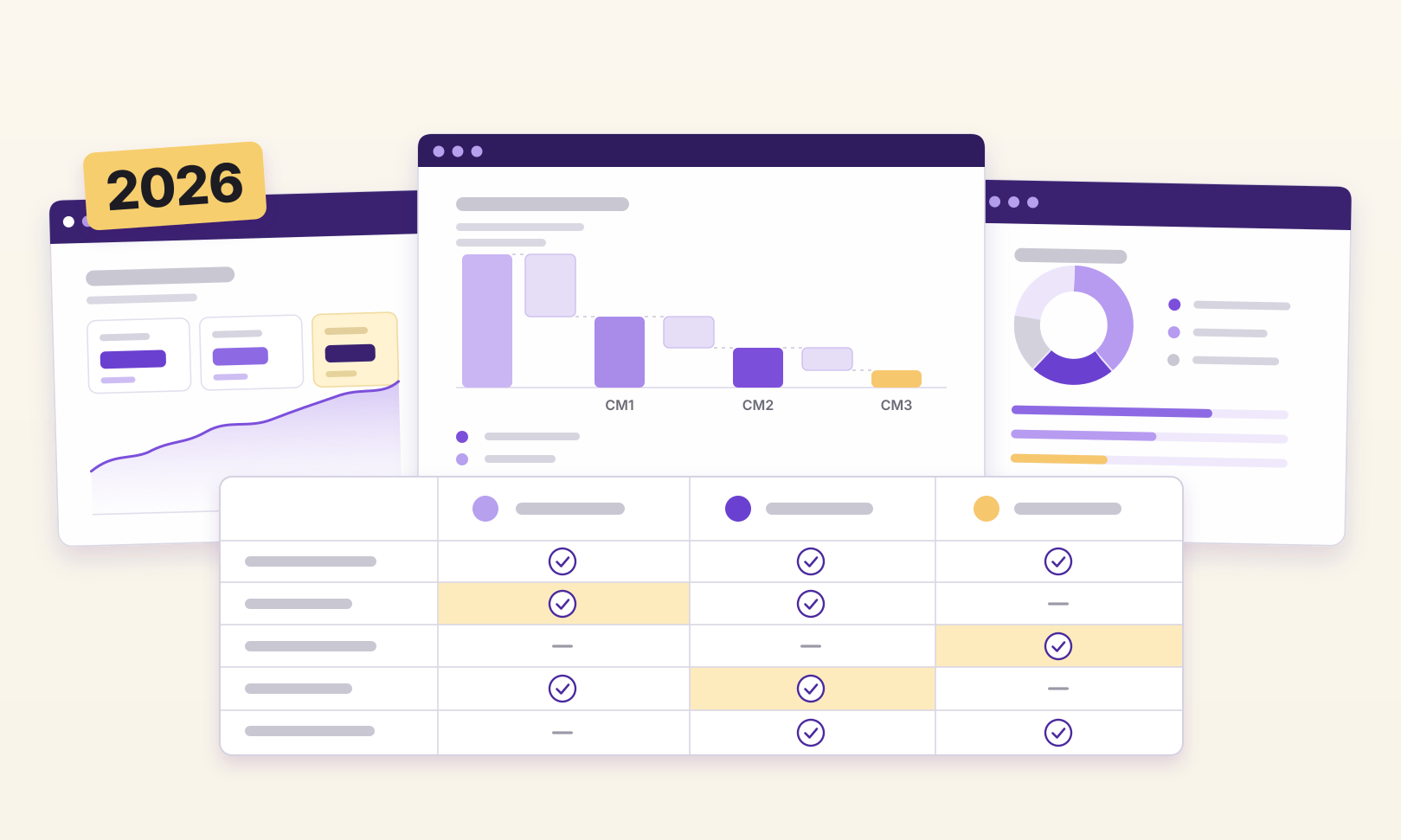
- Klar: Klar gives your team one source of truth from the order to CM3 and EBITDA. It reaches its full value for brands that sell in European markets, because it maps the costs that change from market to market: shipping per region and weight class, payment fees per provider and country, and taxes. Brands that sell in one country can still map their own specific cost logic in Klar, with the cost rules that apply to their market. Core starts from €200/month and Core + Attribution from €400/month.
- Triple Whale: Triple Whale includes attribution in every plan and names no amount on its pricing page. Its price follows annual GMV, and its listed prices assume a 12-month commitment.
- Polar Analytics: Polar Analytics bundles Business Intelligence with multi-touch attribution in its Core Plan. Its terms tie the price to the chosen plan and the GMV tier shown on the platform.
- Admetrics: Admetrics prices reporting and attribution by ad spend. Growth costs €399/month with monthly billing and includes €20,000 of ad spend per month.
- Lifetimely: Lifetimely offers cohort and LTV reporting for Shopify, priced by monthly orders per store. Plan S costs $49/month per Shopify store for up to 500 orders.
- adtribute: adtribute sells reporting with attribution in its Insights plan from €649/month, priced by net revenue and features. Insights is the comparable package, because adtribute lists BI dashboards, retention analytics and the margin structure as not included in its cheaper Attribution plan.
We built Klar, which 1,000+ eCom brands use, and it is one of the six platforms in this comparison. How we compare eCommerce tools explains our method. Every table shows what the vendors document on their own pages.
eCommerce brands need one source of truth
Three numbers answer different questions about the same month: the platform ROAS, the Shopify revenue and the finance margin. The ad platform reports the revenue it credits to its own campaigns, which is why Klar recommends its own attribution over platform data. Shopify reports orders and revenue before your costs. Finance reports a margin after costs.
Your team only agrees on one number when all three come from the same orders: the channel that brought each order in, what that order cost to acquire, and the margin it left after costs. Attribution assigns orders and revenue to marketing touchpoints, and our eCommerce attribution tools comparison explains how to choose a tool for it. Reporting is the layer that turns attributed revenue into CM3 and customer value, calculated from your own orders and costs.
All six platforms in this comparison bring shop orders, ad spend and costs into one account. They differ in how costs enter the shared number. At Klar, datasource rules define which orders and costs enter every report. adtribute takes a different approach: in its Semantic Layer, you define operating expenses, product costs and COGS yourself, at any level of detail. Klar gives you a ready structure for European costs, adtribute a cost model you build on your own. The comparison table further down lists the cost inputs each platform accepts per order.
Which eCommerce reporting tool fits which brand?
The right eCommerce reporting tool depends on your shop system, your cost logic and the markets you sell in. Klar fits DTC brands that want reporting first and exact numbers to act on, from order to CM3. Admetrics comes closest to Klar on margin stages, adtribute on DACH shop systems and EU hosting.
A European brand has different costs in every market it serves, and a margin number is only right if it follows them. Klar sets logistics costs per region and weight bucket, transaction costs per payment provider and taxes per product. Among the other five, Admetrics names the same margin stages, CM1, CM2 and CM3, plus EBITDA, in every plan.
Data sovereignty is the second question for European brands. Klar states in its Trust Center that its platform is hosted in the European Union, and that it processes personal data in accordance with the GDPR. GUTcert lists Klar Insights GmbH as certified to DIN EN ISO/IEC 27001:2024, valid until 21 January 2029.
Admetrics and adtribute state that they process data in the EU. Neither lists an ISO certification on the pages we checked. Triple Whale and Polar Analytics name the US among their data locations.
I think the first question is not which dashboard looks best. It is whether the numbers behind the dashboard follow your own cost rules, because every budget decision rests on them.
Which KPIs should an eCommerce KPI dashboard show?
An eCommerce KPI dashboard should show revenue, profit and acquisition against your targets. Revenue ratios such as MER and ROAS show how efficiently you spend. A profit ratio shows what that spend leaves after costs.
Klar, Admetrics, Polar Analytics and Triple Whale put a profit ratio next to ROAS. With Core + Attribution, Klar reports POAS, a profit-based return on ad spend, and aPOAS. Admetrics also reports POAS, according to its profit intelligence page. Polar Analytics lists Blended POAS in its metric directory, and Triple Whale describes POAS in its own training material.
Klar and Admetrics also report the Marketing Profit Ratio (MPR), which relates CM2 to marketing spend, and an acquisition version, aMPR. Klar's aMPR uses the CM2 of new customers only. Admetrics' aMPR counts new and reactivated customers, and its New MPR covers new customers only.
With Klar Pulse, shop orders sync with Klar almost instantly and Meta and Google update every 20 minutes. Admetrics lists data updates every 4 hours on Growth and Business on its pricing page, with faster updates as an add-on.
How do you report profit per channel?
You report profit per channel down to CM3 by deducting product, fulfilment, payment and marketing costs per order and then grouping the result by channel. Klar, Admetrics and adtribute name the stages CM1 to CM3. Triple Whale reports Net Profit, and Lifetimely reports one contribution margin and Net Profit. This profitability report provides a good overview and defines each stage as follows.
ROAS alone hides most of this. Let's say, with made-up numbers, that two channels each spend €8,000 and each bring in €32,000 of net revenue, so both show a ROAS of 4. Channel A sells products whose variable costs take 45% of revenue. Channel B sells more discounted bundles and gets more returns, so its variable costs take 65%.
The ad platform shows two identical channels. Channel A still earns three times as much contribution margin after marketing. I think this is why a ROAS target alone cannot set a channel budget. The budget needs the cost structure behind each order.
How do you track customer lifetime value by channel?
You track customer lifetime value by channel by grouping customers by the channel of their first order and following the margin they generate over time. The six platforms calculate that value on different bases.
Klar uses Contribution Margin 2 to describe its CLV. Triple Whale and Polar Analytics define customer lifetime value on revenue. Admetrics also defines CLV on CM2 and reports revenue separately as CLR.
Klar's Retention Trends report shows CLV by the last-click channel of each customer's first order, with a red line for the blended CAC. A CLV to CAC ratio above 1 means your customers are profitable after marketing. Attributed CLV under a chosen model sits in the Attribution Deep Dive and needs Core + Attribution.
Which eCommerce analytics tools connect to ChatGPT or Claude via MCP?
All six platforms document an MCP connection for AI assistants such as ChatGPT or Claude. Klar, Triple Whale, Admetrics and adtribute describe their connection as read-only. Polar Analytics reads its data and can also create, update and delete custom metrics, dimensions and labels inside Polar.
eCommerce reporting and analytics tools compared
The table compares the six platforms on the same seven criteria, from reporting without attribution to MCP access. Klar is the only platform here that sells reporting on its own in Core and adds attribution with Core + Attribution.
Which shop systems does each eCommerce reporting tool connect to?
All six platforms connect Shopify. Klar, Admetrics and adtribute also connect Shopware, and only adtribute lists Plentymarkets. In the table, direct means the vendor connects the system itself.
Which eCommerce analytics tools integrate Meta, Google, TikTok, Klaviyo and Amazon?
Klar pulls cost data from all five, plus Pinterest and Bing, according to its shop system article. From Amazon, Klar also pulls order data. For Klaviyo, Klar reads the event stream of opens, clicks and purchases instead of Klaviyo's own revenue numbers.
The other five list their Amazon connections in the shop system table above. Triple Whale connects Amazon Seller Central, Amazon Ads and Vendor Central. Lifetimely pulls order, sales and ad data from Amazon Seller Central as a $75/month add-on.
What does an eCommerce reporting tool cost?
eCommerce reporting tools in this comparison price by net revenue, GMV, ad spend or monthly orders.
We checked prices and product pages on 6 and 7 November 2026. Klar states its prices net plus VAT.
How do the six eCommerce reporting tools compare one by one?
Each of the six platforms gets its own profile below. Every profile lists core capabilities and where the platform falls short.
Klar
Klar is the eCommerce Attribution and Reporting Platform for profitable growth. Its reporting package Core can be bought on its own. Core + Attribution adds the first-party pixel and the advanced measurement suite from €400/month.
Core capabilities
- A defined P&L to EBITDA: The profitability report runs from net revenue through CM1, CM2 and CM3 to EBITDA, with a published formula for each stage. MPR and aMPR set CM2 against marketing costs, and aCM2 shows the CM2 of new customers.
- Profit by any dimension: The Revenue & Profit Flex Table works like a pivot table over 48 dimensions, including SKU, channel, shipping country, discount code and new versus repeat customers.
- European cost logic: Shipping follows region and weight, payment fees follow the provider and country store, and taxes follow each product. Each cost entry carries a date range and runs through every margin stage.
- Customer value on margin: Cohort reports track accumulated CM2 per customer as CLV. Cohorts can be compared by first-order channel or product, and break-even targets for CAC are monitored per cohort.
- Reporting without an attribution bundle: The Core Plan covers profitability, retention and acquisition reporting, down to creatives and influencers, with unlimited users.
Where it falls short
- Below €1M in net revenue: Klar's pricing page names €1M as the starting point, so smaller stores may find a cheaper start elsewhere.
Triple Whale
Triple Whale Inc. is based in Columbus, Ohio. Every plan includes attribution, from first- and last-click models in Free to all models in the paid plans.
Core capabilities
- Profit: Net Profit deducts refunds, ad spend and Total Costs. Total Costs include COGS, payment and shipping costs, among others.
- Cohorts: Cohorts can be filtered by the attribution of the first order. NCPA Payback compares new-customer CPA with total sales.
Where it falls short
- Customer value basis: The LTV metric is order revenue per unique customer, so product and fulfilment costs are not deducted. Triple Whale's cohort guide lists a breakdown by first-order channel as "coming soon".
- Pricing and term: Triple Whale's pricing page names no amount, and its price follows annual GMV and the chosen package. Its listed prices assume a 12-month commitment, with month-to-month also offered.
Klar vs Triple Whale
Both cover
Attribution in every plan, and shop, ad and cost data in one account.
Where they differ
Europe versus US: Klar maps European cost logic: logistics costs per region and weight bucket, transaction costs per payment provider, taxes per product, daily spot-rate conversion and costs per country store. Klar connects Shopware, Magento, Centra, BigCommerce and JTL next to Shopify and WooCommerce. Triple Whale connects Shopify, WooCommerce and BigCommerce, and Magento through a custom connection.
Data location: Klar states in its Trust Center that its platform is hosted in the EU, and GUTcert certifies it to ISO/IEC 27001. Triple Whale's privacy notice names the US, Europe, Israel and other locations, and its trust center lists a SOC 2 Type 2 report.
Attribution and contract: Triple Whale's Compass combines multi-touch attribution, marketing mix modelling and incrementality testing and is included in the Enterprise plan, and it may be available separately for eligible plans. Klar's Core + Attribution, from €400/month, includes a marketing mix model (MMM) and geo-lift incrementality tests, and its monthly option can be cancelled each month.
Verdict
Klar is the better choice when you sell in several countries in Europe, want customer value on margin or need EU hosting. Triple Whale is the better choice when you sell mainly in the US.
Polar Analytics
Polar Analytics bundles Business Intelligence, AI Agents and Data Activations in its Core Plan. Business Intelligence includes multi-touch attribution, alerts and scheduled reports.
Core capabilities
- Profit views: Polar analyses profit by store, product and country, and by channel and campaign.
- MCP access: Polar's MCP connection reads data and can also create, update and delete custom metrics, dimensions and labels inside Polar.
Where it falls short
- Data location: Its terms say personal data is stored and processed primarily in the US and the EU, while its website FAQ says data is hosted in the US by default, with EU hosting on request.
- Customer value basis: Polar defines customer lifetime value on revenue, so product and fulfilment costs stay in the number.
Klar vs Polar Analytics
Both cover
Multi-touch attribution, daily currency conversion and profit analysis by country.
Where they differ
Single source of truth: Klar ties CM2-based customer value to CAC and attribution on the same orders and adds country stores with their own costs and channels. It includes a marketing mix model and geo-lift incrementality tests in Core + Attribution, while Polar's pricing page lists Incrementality Testing only in its Custom Plan, without a published price.
Shop systems and hosting: Klar connects Shopware, WooCommerce, Magento, JTL, Centra, Oxid and Amazon next to Shopify and states EU hosting with ISO/IEC 27001 certification. Polar builds on Shopify, lists Amazon Seller Central and TikTok Shop as one-click connectors, and its website FAQ says US by default with EU hosting on request.
Verdict
Klar is the better choice when you run Shopware, WooCommerce or Magento next to Shopify and want MMM and incrementality in the plan with customer value on margin. Polar is the better choice when you run on Shopify and want BI and multi-touch attribution in one GMV-priced plan, with Amazon Seller Central and TikTok Shop as one-click connectors.
Admetrics
Admetrics is a company based in Frankfurt. Every published Admetrics plan includes multi-touch and data-driven attribution.
Core capabilities
- P&L: The P&L report runs through CM1, CM2 and CM3 to EBITDA.
- Currencies and shops: Multi-currency conversion and multi-shop support are part of every plan.
Where it falls short
- Custom metrics: Custom metrics and dimensions are listed in the Custom plan.
- Marketing mix model: Admetrics lists its marketing mix model as an add-on in the Custom plan.
Klar vs Admetrics
Both cover
Multi-touch attribution, the margin stages CM1 to CM3 and EBITDA, and customer value on margin. Both report MPR and aMPR, which set CM2 against marketing costs. Klar's aMPR uses new customers only, while Admetrics' aMPR counts new and reactivated customers.
Where they differ
Billing basis: Klar prices by net revenue, and Admetrics by ad spend. Both Klar Core + Attribution and Admetrics include attribution, so that is the fair comparison. Admetrics' plans include a set ad spend per month and charge a percentage above it, so the price follows your ad budget. The larger the brand and its ad budget, the faster this price can rise compared with a price based on net revenue, and it usually ends up higher. The actual price has to be checked individually for your brand.
MMM and setup: Klar includes a marketing mix model and geo-lift incrementality tests in Core + Attribution, plus country stores, currency conversion and custom groups in Core. Admetrics lists its marketing mix model as an add-on in the Custom plan, multi-market views from Business and custom dimensions in Custom.
Verdict
Klar is the better choice when you want MMM and incrementality in the plan and a price that does not rise with ad spend. Admetrics is the better choice when you want a price tied to ad spend rather than net revenue and prefer to add MMM as an add-on in its Custom plan.
Lifetimely
Lifetimely is run by Lifetimely Singapore Pte Ltd, part of the Amp group. Attribution is part of every paid plan.
Core capabilities
- Cohorts: LTV cohorts can be cut by first product and discount code, with first- and last-touch channel filters.
- Payback: Accumulated gross margin is compared with CAC.
Where it falls short
- Custom metric filters: Contribution Margin, Net Profit and Marketing Costs cannot be filtered in the custom metric builder.
- Platform coverage: Lifetimely builds on Shopify, and Amazon Seller Central is a $75/month add-on.
Klar vs Lifetimely
Both cover
Post-purchase surveys, new-customer ROAS and customer value reporting.
Where they differ
Attribution: Lifetimely attributes with first-touch and last-touch UTM data, and its help center says attribution currently supports Facebook, Google and TikTok. Klar measures with its own first-party script under your subdomain. Core + Attribution adds multi-touch models with a data-driven model, plus MMM and geo-lift tests.
Customer value and shops: Klar shows CLV on CM2 against blended CAC by first-order channel and prices on your net revenue of the last 12 months, with multi-shop support in Core. Lifetimely needs one subscription per Shopify store. Klar connects Shopware, WooCommerce, Magento, JTL, Centra, Oxid and Amazon next to Shopify.
Verdict
Klar is the better choice when you run several stores or shop systems and want multi-touch attribution with MMM and customer value on margin in one account. Lifetimely is the better choice when you run a single Shopify store and want cohort LTV by first product and discount code at a price set by monthly orders.
adtribute
Adtribute Software GmbH is based in Germering, Germany. According to its compliance page, it processes customer data on EU infrastructure by default.
Core capabilities
- Attribution models: adtribute offers five standard models, from last touch to full impact. Lookback windows run from one day to unlimited. Custom models are built and calibrated with its data team.
- Costs at any granularity: Operating expenses, product costs and COGS can be set at any granularity in its Semantic Layer.
Where it falls short
- Plan gates: Custom shop systems and the Amazon connection through Sellerboard are part of Insights, not the Attribution plan.
- Reporting gap in the Attribution plan: adtribute lists BI dashboards, retention analytics and the margin structure as not included in its cheaper Attribution plan, so reporting needs Insights from €649/month.
Klar vs adtribute
Both cover
Shopify, Shopware and WooCommerce, attribution, and post-purchase survey data in attribution.
Where they differ
Buying reporting: Klar Core is sold without an attribution bundle, from €200/month. adtribute's reporting plan Insights includes attribution and starts at €649/month.
Attribution and shops: adtribute offers rule-based and custom attribution models. Klar's Core + Attribution adds a marketing mix model and geo-lift incrementality tests, and its Attribution Deep Dive shows CM1 to CM3 and CLV for each channel. Klar also connects Centra, Oxid and Amazon directly, Magento through official modules and JTL-Wawi through the JTL-Klar-Sync.
Verdict
Klar is the better choice when you want reporting on its own from €200/month and direct connections to Centra and Oxid, with MMM in the attribution plan. adtribute is the better choice when you are a DACH brand on Plentymarkets or want custom attribution models built with a data team.
FAQ
Which eCommerce reporting tool fits my shop system?
All six platforms connect Shopify. Beyond that, the shop system table above lists each direct connection, module and add-on. Klar, Admetrics and adtribute cover Shopware directly, and only adtribute lists Plentymarkets. Polar Analytics and Lifetimely build on Shopify.
Which eCommerce reporting tool shows profit down to CM3?
Klar, Admetrics and adtribute name the stages CM1 to CM3, and Klar and Admetrics continue to EBITDA. Polar Analytics reports CM1 to CM4 with its own definitions, Triple Whale reports Net Profit, and Lifetimely reports one contribution margin and Net Profit. The stages are only as good as the costs behind them. The comparison table above lists the cost inputs per order for each platform.
Which eCommerce reporting tool calculates customer lifetime value on margin?
Klar calculates CLV as CM2 divided by customers. Admetrics defines CLV as lifetime CM2 per new customer and reports revenue separately as CLR. Lifetimely uses accumulated gross margin, and adtribute offers a CM2 90d metric. Triple Whale and Polar Analytics define customer lifetime value on revenue, so product and fulfilment costs stay in the number.
Which eCommerce reporting tool fits European brands with GDPR requirements?
Klar, Admetrics and adtribute state that they process data in the EU. Only Klar lists an ISO/IEC 27001 certificate, issued by GUTcert and valid until 21 January 2029, and we found no ISO certification on the Admetrics and adtribute pages we checked. Triple Whale names the US, Europe, Israel and other locations and lists a SOC 2 Type 2 report. Polar Analytics' terms name the US and the EU, and its website FAQ says US by default with EU hosting on request.
Which eCommerce reporting tool works for several stores or markets?
Klar and Admetrics both include multi-shop support, while Lifetimely needs one subscription per Shopify store. In Klar, Core covers several ad accounts and country stores with their own costs and channels. Admetrics includes multi-currency conversion in every plan and multi-market views from Business. Polar Analytics analyses profit by country, and Triple Whale offers country allocation on paid plans.
How much does an eCommerce reporting tool cost?
The prices scale with different metrics, so compare equal packages. Klar Core + Attribution starts at €400/month and scales with net revenue, Admetrics Growth costs €399/month with €20,000 of ad spend included, and adtribute Insights starts at €649/month. Polar Analytics names no amount in its terms or on the pricing page we checked, and Lifetimely starts at $49/month per Shopify store for up to 500 orders.
Triple Whale names no amount, and its listed prices assume a 12-month commitment, with month-to-month also offered. Klar's monthly option can be cancelled each month. Klar's pricing page names €1M in net revenue as the starting point, so smaller stores may find a cheaper start elsewhere.
Do I need attribution in my eCommerce reporting tool?
Klar is the only platform here that sells reporting on its own: Core starts at €200/month, and attribution comes with Core + Attribution from €400/month. The other five include attribution in every plan or in their entry package, so Klar Core + Attribution is the closer comparison for them. If you want profit and customer value first, a reporting-only package avoids paying for attribution you do not use yet.
Related reading
- eCommerce attribution tools compared covers the attribution building block in depth.
- Best European alternatives to Triple Whale compares options for brands leaving Triple Whale.
- How we compare eCommerce tools explains our methodology.
Want one source of truth by next Monday?
Klar's 14-day free trial starts once your account is fully set up, and onboarding has no setup cost. Bring your cost structure and the three numbers your team argues about today.